
Miners use hashing to solve mathematical puzzles and validate transactions
In proof-of-work systems, mining relies on hashing: miners use computational power to solve mathematical puzzles, validate transactions, and maintain blockchain integrity.
TechnoLynx worked with a client exploring disruptive ideas in cryptocurrency to assess whether a specific proof-of-work mining algorithm could be accelerated to improve overall hash rate performance and mining efficiency.
In proof-of-work systems, mining relies on hashing: miners use computational power to solve mathematical puzzles, validate transactions, and maintain blockchain integrity.
As mining difficulty increased, CPUs became insufficient and miners moved to GPUs for their efficiency on these workloads.
ASICs are even more specialised and can be faster and more efficient than GPUs, but they are more expensive and less versatile. There is ongoing debate about proof-of-work versus alternatives like proof-of-stake, which aim to reduce energy requirements.
The client wanted to evaluate whether meaningful improvements could be made to a cryptocurrency mining algorithm. Their goal was to identify potential avenues for faster, more efficient mining, ideally improving performance and profitability, within a proof-of-work system.
Hash-rate performance focus
Identify where the mining algorithm could be accelerated, with an emphasis on improving overall hash rate.
Hardware constraints
Mining is energy-intensive and depends on powerful compute hardware such as GPUs (and sometimes ASICs), which can impose hard performance limits.
Find real bottlenecks
Determine whether performance headroom exists in the algorithm itself, or whether the bottlenecks sit elsewhere (e.g., GPU limitations).

Cryptocurrency statistics (Unsplash).
From mining-algorithm analysis to heuristic exploration and GPU bottleneck investigation
Analysed the existing mining algorithm, focusing on operational efficiency and performance bottlenecks, including potential acceleration via GPUs or ASICs.
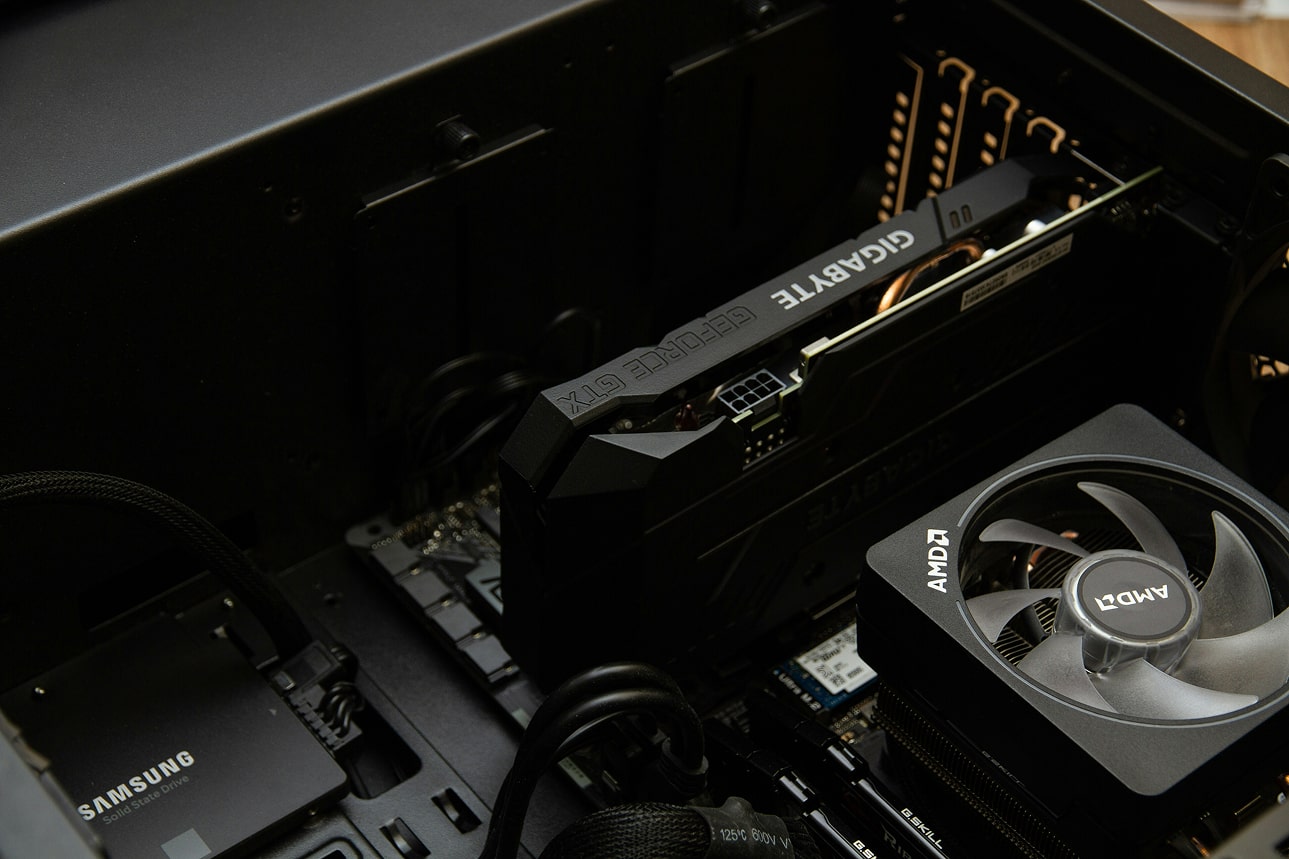
Found that GPU implementations were already highly optimised, with performance nearing hardware limits, particularly around DRAM bandwidth, leaving little room for further gains in the core approach.
Explored heuristic methods, using “educated guesses” to bypass certain computations. Implemented a proof of concept; results were promising but not significant enough to justify deeper investment.
Shifted focus to performance bottlenecks tied to specific GPUs. Identified areas where certain GPUs underperformed due to hardware limitations and design inefficiencies, and suggested mitigation approaches.
Concluded that additional improvements would likely be incremental. The client decided not to pursue further development and redirected resources to more promising work, supported by a clear, independent analysis.
TechnoLynx conducted a thorough analysis of the existing infrastructure and the mining algorithm, identified current performance bottlenecks, and assessed whether acceleration through better use of GPUs or potential ASIC implementation was possible. After finding existing GPU implementations were already highly optimised and near hardware limits (particularly DRAM bandwidth), we explored heuristic methods via a proof of concept, then shifted focus to bottlenecks associated with specific GPUs and suggested mitigation methods.
Evaluated efficiency and bottlenecks in the mining algorithm and assessed whether acceleration via improved GPU usage or ASIC implementation could plausibly deliver meaningful gains.
Investigated heuristic methods that bypass parts of the computation. Built a proof of concept; while encouraging, gains were not large enough to justify continued investment.
Identified bottlenecks affecting specific GPUs and proposed mitigation options, including approaches tied to hash-rate calculations and transaction fee management.
The client decided not to pursue further development, based on the conclusion that the mining algorithm was already performing at a high level and the remaining optimisation headroom would not justify additional investment.
The project still delivered value by providing a thorough, independent analysis and clear recommendations, supporting an informed decision and a shift toward more promising ventures.
Performed a deep analysis of the mining algorithm and its performance bottlenecks
Confirmed existing GPU implementations were already highly optimised, nearing hardware limits (notably DRAM bandwidth)
Built and evaluated a heuristic proof of concept to test alternative acceleration strategies
Identified GPU-specific bottlenecks and proposed mitigation methods where practical
Helped the client make an informed ROI decision, avoiding investment in low-upside optimisation work
Provided a clear understanding of limitations and potential improvement directions for future exploration
Our services feature expertise in classical computer vision, human-supervised system design for legal compliance, video pipeline optimisation with tools like FFmpeg, custom adaptable models, and explainable AI for ethical transparency.


We are leaders in generative AI, offering optimised inference for faster deployments, ethical AI systems with bias mitigation, intelligent automation for adaptive workflows, and advanced simulation and prototyping capabilities.

We deliver immersive XR solutions with cross-platform development (Unity 6), GPU performance optimisation, and expertise in NVIDIA Omniverse and CloudXR. We also use reinforcement learning for intelligent XR environments.

We can analyse your GPU workloads, identify true bottlenecks, and validate whether optimisation work will deliver meaningful ROI.


